'%3e%3cpath%20d='M706.453%20375.999C860.234%20375.999%20984.899%20291.829%20984.899%20188C984.899%2084.1703%20860.234%200%20706.453%200C552.671%200%20428.006%2084.1703%20428.006%20188C428.006%20291.829%20552.671%20375.999%20706.453%20375.999Z'%20fill='%23009B4F'/%3e%3cpath%20d='M278.447%20375.999C432.229%20375.999%20556.893%20291.829%20556.893%20188C556.893%2084.1703%20432.229%200%20278.447%200C124.665%200%200%2084.1703%200%20188C0%20291.829%20124.665%20375.999%20278.447%20375.999Z'%20fill='%23009B4F'/%3e%3cpath%20d='M141.484%20166.68C125.01%20162.158%20114.996%20158.927%20114.996%20150.529C114.996%20143.422%20122.102%20138.9%20133.085%20138.9C144.068%20138.9%20155.051%20143.099%20164.095%20150.529L164.418%20150.852L165.388%20129.855C156.666%20125.01%20147.944%20121.78%20133.731%20121.78C123.394%20121.78%20114.027%20124.364%20107.243%20129.209C99.8137%20134.378%2095.9374%20142.13%2095.9374%20151.175C95.9374%20168.941%20110.796%20176.694%20123.394%20179.924C140.192%20184.446%20151.821%20188.323%20151.821%20198.659C151.821%20207.381%20144.068%20212.872%20131.47%20212.872C118.872%20212.872%20106.274%20207.381%2096.5834%20198.013L96.2604%20197.69L94.3223%20219.979C104.336%20226.762%20116.934%20230.316%20130.501%20230.316C142.13%20230.316%20152.144%20227.408%20159.25%20221.917C167.003%20216.103%20171.202%20207.704%20171.202%20197.367C171.202%20181.862%20161.511%20171.848%20141.484%20166.68Z'%20fill='white'/%3e%3cpath%20d='M264.557%20188C264.557%20215.78%20246.467%20230.316%20225.471%20230.316C215.457%20230.316%20207.381%20226.762%20201.244%20221.271V253.896H182.186V146.976H201.244V156.02C207.704%20149.883%20216.103%20145.684%20226.763%20145.684C247.436%20145.36%20264.557%20160.22%20264.557%20188ZM245.498%20188C245.498%20172.494%20236.131%20162.158%20222.887%20162.158C214.811%20162.158%20207.058%20165.711%20201.567%20173.787V203.182C207.058%20210.288%20214.488%20213.841%20222.887%20213.841C236.131%20213.841%20245.498%20203.505%20245.498%20188Z'%20fill='white'/%3e%3cpath%20d='M352.095%20194.137H294.274C296.535%20207.058%20305.903%20213.841%20318.824%20213.841C329.807%20213.841%20337.882%20211.257%20346.604%20206.089L347.573%20222.886C339.82%20227.085%20330.13%20230.316%20317.532%20230.316C294.274%20230.316%20274.893%20215.78%20274.893%20188.323C274.893%20162.804%20294.274%20145.683%20317.209%20145.683C341.112%20145.683%20353.71%20160.22%20353.71%20181.216C353.71%20185.415%20353.064%20189.615%20352.095%20194.137ZM335.621%20178.632C335.621%20168.618%20329.161%20160.866%20317.532%20160.866C306.549%20160.866%20296.858%20168.295%20294.597%20180.893H335.298C335.621%20180.247%20335.621%20179.601%20335.621%20178.632Z'%20fill='white'/%3e%3cpath%20d='M443.189%20221.917L445.128%20203.505C452.88%20209.965%20463.54%20213.841%20474.846%20213.841C482.921%20213.841%20488.413%20210.611%20488.413%20204.797C488.413%20189.615%20444.482%20197.367%20444.482%20169.91C444.482%20153.436%20458.695%20145.36%20475.492%20145.36C487.444%20145.36%20496.488%20148.268%20503.272%20152.467L502.303%20169.587C494.227%20164.096%20484.213%20161.189%20475.492%20161.189C468.708%20161.189%20463.217%20163.773%20463.217%20168.941C463.217%20181.862%20507.471%20175.402%20507.471%20203.828C507.471%20221.271%20492.289%20229.993%20474.523%20229.993C461.602%20230.316%20450.942%20227.085%20443.189%20221.917Z'%20fill='white'/%3e%3cpath%20d='M590.488%20177.986V228.701H571.429V220.302C564.969%20226.439%20556.57%20229.993%20546.88%20229.993C528.467%20229.993%20517.484%20219.01%20517.484%20203.505C517.484%20187.03%20530.405%20177.017%20549.464%20177.017C556.57%20177.017%20563.677%20178.309%20571.752%20180.57V177.986C571.752%20165.388%20562.385%20159.897%20550.756%20159.897C542.034%20159.897%20532.02%20163.127%20524.914%20168.941L524.268%20152.467C530.405%20148.268%20541.711%20145.037%20554.309%20145.037C574.983%20145.36%20590.488%20155.374%20590.488%20177.986ZM571.429%20206.735V194.46C564.646%20192.199%20558.185%20190.907%20551.402%20190.907C541.711%20190.907%20535.574%20196.075%20535.574%20203.505C535.574%20210.934%20542.034%20215.78%20550.433%20215.78C558.508%20215.78%20564.969%20212.872%20571.429%20206.735Z'%20fill='white'/%3e%3cpath%20d='M592.104%20146.976H612.777L636.358%20198.659L659.616%20146.976H680.289L641.526%20228.701H630.866L592.104%20146.976Z'%20fill='white'/%3e%3cpath%20d='M754.907%20194.137H697.409C699.67%20207.058%20709.038%20213.841%20721.959%20213.841C732.941%20213.841%20741.017%20211.257%20749.739%20206.089L750.708%20222.886C742.955%20227.085%20733.264%20230.316%20720.667%20230.316C697.409%20230.316%20678.027%20215.78%20678.027%20188.323C678.027%20162.804%20697.409%20145.683%20720.343%20145.683C744.247%20145.683%20756.845%20160.22%20756.845%20181.216C756.522%20185.415%20756.199%20189.615%20754.907%20194.137ZM738.756%20178.632C738.756%20168.618%20732.295%20160.866%20720.667%20160.866C709.684%20160.866%20699.993%20168.295%20697.732%20180.893H738.433C738.433%20180.247%20738.756%20179.601%20738.756%20178.632Z'%20fill='white'/%3e%3cpath%20d='M826.618%20148.914L824.034%20166.357C819.511%20163.773%20814.989%20163.127%20810.467%20163.127C802.068%20163.127%20794.315%20167.326%20788.824%20176.371V228.701H769.766V146.976H788.824V157.958C794.315%20150.529%20802.068%20145.36%20812.728%20145.36C817.896%20145.36%20822.418%20146.653%20826.618%20148.914Z'%20fill='white'/%3e%3cpath%20d='M832.109%20221.917L834.048%20203.505C841.8%20209.965%20852.46%20213.841%20863.766%20213.841C871.841%20213.841%20877.333%20210.611%20877.333%20204.797C877.333%20189.615%20833.401%20197.367%20833.401%20169.91C833.401%20153.436%20847.615%20145.36%20864.412%20145.36C876.364%20145.36%20885.408%20148.268%20892.192%20152.467L891.223%20169.587C883.147%20164.096%20873.133%20161.189%20864.412%20161.189C857.628%20161.189%20852.137%20163.773%20852.137%20168.941C852.137%20181.862%20896.391%20175.402%20896.391%20203.828C896.391%20221.271%20881.209%20229.993%20863.443%20229.993C850.522%20230.316%20839.862%20227.085%20832.109%20221.917Z'%20fill='white'/%3e%3cpath%20d='M429.298%20206.412C422.838%20211.257%20416.054%20213.841%20408.302%20213.841C395.058%20213.841%20383.429%20204.474%20383.429%20188C383.429%20171.525%20395.058%20162.158%20408.302%20162.158C416.054%20162.158%20422.838%20164.742%20429.298%20169.264C430.268%20163.45%20431.237%20157.958%20432.852%20152.467C426.068%20148.591%20417.67%20145.683%20406.041%20145.683C382.783%20145.683%20363.725%20161.512%20363.725%20188C363.725%20214.487%20382.783%20230.316%20406.041%20230.316C417.67%20230.316%20426.068%20227.085%20432.852%20222.886C431.237%20217.395%20429.944%20211.903%20429.298%20206.412Z'%20fill='white'/%3e%3c/g%3e%3cdefs%3e%3cclipPath%20id='clip0_1478_9029'%3e%3crect%20width='984.9'%20height='375.999'%20fill='white'/%3e%3c/clipPath%3e%3c/defs%3e%3c/svg%3e)
What is a corneal abrasion (scratched eye)?
In this guide, you'll learn more about the symptoms of a corneal abrasion and what might cause it. We'll also look at diagnosis, corneal abrasion treatment, and how to protect yourself from this kind of injury.
Understanding corneal abrasions
A corneal abrasion is the medical name for a scratch on the front surface of your eye. The cornea is the clear, protective layer that covers the front of the eye. A scratch to this area can be very painful, often leads to red eye, and may make your eye extra sensitive to light.
Corneal abrasions can happen in all sorts of ways – from getting poked in the eye, to something flying into it, or even rubbing your eyes too hard. While they’re uncomfortable, most scratches are minor and clear up in a couple of days. If the injury is more serious, your optometrist can guide you through the right treatment to help it heal properly.
What the experts say about corneal abrasion
A corneal abrasion is a scratch on the surface of your eye. It can feel gritty or painful, like there’s something stuck in your eye. Our optometrists can check for damage using a special dye and light. Most scratches heal quickly with the right care – often just lubricating drops and a short break from contact lenses.
Symptoms of corneal abrasion (eye scratch)
Have you noticed one of your eyes hurts, or feels uncomfortable? It could be a corneal abrasion. Depending on how the eyeball scratch happened, and how large the scrape is, you could experience some of the following kinds of symptoms.
If you experience any of these symptoms, it's important to get your eyes checked. Although corneal abrasions often clear up by themselves, they can get infected if not treated. So, visit an optometrist as soon as you can.
Eye pain
Particularly when opening or closing the injured eye (it might be worse in the morning when you wake up).
Learn more about eye pain
Watery eyes
You might notice your eyes are much more watery or teary than usual.
Learn more about watery eyes
Red or bloodshot eyes
This is when the whites of your eyes appear pink with blood vessels more visible than usual.
Learn more about red or bloodshot eyes
Blurry vision
Which makes things appear distorted or unclear.
Learn more about blurry vision
Book an eye testWhat can cause a scratched eye?
Lots of things can lead to a scratched eye, but there are some causes that optometrists see more often than others. These include accidentally poking your eye with a finger or nail, or getting something sharp like grit, sand or dust in your eye. Contact lens wearers sometimes develop scratches if they leave daily lenses in overnight, or if lenses aren’t cleaned properly. Rubbing your eyes too hard – especially if there’s something already in them – can also cause damage.
Other common causes include scratching your eye while putting on makeup, dry eye syndrome (when your eyes don’t make enough tears), and getting flicked in the eye by a leaf or twig outdoors. Sports like martial arts, squash or tennis can also pose a risk, especially if something hits the eye at speed. Less common but possible causes include exposure to UV light (such as in tanning salons or very bright sun) and chemical splashes, either in the workplace or from household cleaning products.
Learn more about dry eye syndrome
Book an eye testNormal eye vs scratched eye
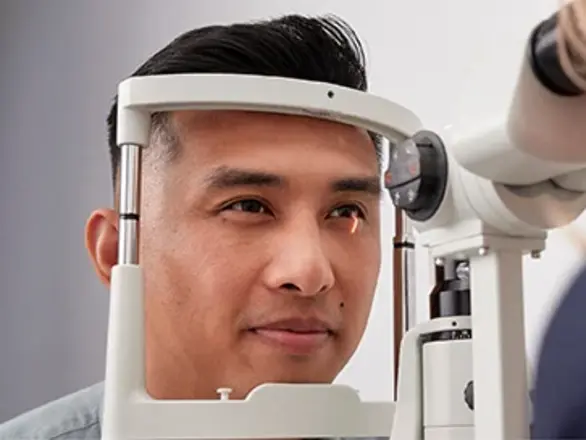
A corneal abrasion isn’t usually visible to the naked eye, but an optometrist can spot it by using a special orange dye called fluorescein and examining the eye with a slit lamp microscope.
Who is more likely to get a corneal abrasion?
Anyone can get a scratched cornea, but it tends to affect some people more than others. It’s most common in working‑age men, likely due to increased exposure to activities or environments that carry a higher risk of eye injury.
It’s also more likely in contact lens wearers, people with diabetes, and those who’ve previously had damage to the cornea from injury or certain eye conditions.
Learn more about diabetic retinopathy
Diagnosing corneal abrasion
Our optometrists see people with corneal abrasions almost every week. After asking about your symptoms, they’ll use a couple of different methods to check what’s going on. One common method is a slit‑lamp exam. This is a special microscope that lets the optometrist look closely at the surface of your eye.
If a slit lamp isn’t available – for example, if you go straight to the ED – the doctor might use a fluorescent dye instead. A few drops are placed in the affected eye, and a blue light is used to highlight the scratch. This method is safe and helps make the abrasion easier to see.
Eye scratch treatment
Treatment for a corneal abrasion depends on how it happened and how severe your symptoms are. Small scratches often heal on their own in a couple of days. Your optometrist might suggest rinsing the eye, resting it, taking over‑the‑counter pain relief and avoiding bright lights to help it recover.
If the scratch is more serious, you may need extra support. This could include antibiotic eye drops to prevent infection and lubricating ointment to protect the eye and ease discomfort. You can also help things along by wearing sunglasses to reduce light sensitivity, using a cold compress, and avoiding screens until your eye feels better.
When to go to hospital for a scratched eye
A scratched eye is usually minor, but there are times when you’ll need emergency care. Call 111 or go to your nearest emergency department if something is stuck in your eye (not just sitting on the surface), your eye is bleeding, the pain hasn’t eased after 24 hours or is getting worse, chemicals have gone into your eye, your vision changes suddenly (like seeing halos or things looking blurry), or if you feel sick, vomit, black out or feel dizzy.
How long does a scratched eye take to heal?
Healing time depends on how big the scratch is. Smaller corneal abrasions usually heal in two to three days, while larger ones might take four to five days. If your eye is still sore after a few days’ rest, it’s best to book an appointment with an optometrist.
Book an eye testHow to avoid corneal abrasions (scratched eye)
You can lower your risk of scratching your eye by taking a few simple steps. If you work somewhere with flying particles – like a building site, workshop or foundry – wearing protective goggles, glasses or a face shield is important. At home, safety glasses can help prevent injury while gardening or doing DIY jobs.
Sport is another common cause of eye injuries. Wearing proper eye protection in activities like squash, tennis, basketball or martial arts can help keep your eyes safe. It’s also important to be careful with contact lenses – don’t sleep in them unless they’re designed for overnight use, and always follow the instructions for how long to wear them.
Makeup can also lead to scratches if you’re not careful. Use products that are still in date, apply mascara gently, and avoid poking or pulling at your lashes. Taking care with your eyes day to day can help prevent problems later.
Read our contact lenses guide

Scratched eyes FAQs
Yes, eye injuries can heal on their own. If you have a corneal abrasion, it usually just requires plenty of rest to heal. But it's always best to visit an optometrist about any kind of eye injury. They can check how serious the damage is, identify any other problems, and give you the best treatment advice.
If you've scratched your eye during the day, getting plenty of rest overnight will really help with healing. A scratched eye usually takes at least a couple of days to get better, so it may not be fully healed after one night's sleep ‑ but you should notice an improvement. If your optometrist or GP has prescribed you with antibiotic eyedrops or any other medication, follow their instructions
Unfortunately, it's not possible to speed up how your body heals a scratched cornea. This can be frustrating, but it's worth remembering the cornea is already one of the fastest‑healing bits of the human body. You can help your eye by taking plenty of rest and avoiding any activities that could aggravate it (such as looking at bright lights, rubbing the eye or wearing makeup).
We generally advise against driving until your corneal abrasion has fully healed. Corneal abrasions can make your eyes water or make your vision go blurry, which makes driving less safe. Also, if your eye feels gritty or painful, it might distract you from what's happening on the road.
Maybe, but it depends on the cause of the injury, your symptoms, and what your work involves. The problem is that many jobs require intensive eye use ‑ such as staring at screens or driving. This could mean it takes longer for the eye to heal. First, speak with your doctor and with your workplace’s health and safety representative to explore your options.
Yes, your body repairs damage while you're sleeping so it's really helpful to get as much sleep as possible when recovering from a corneal abrasion.
Yes, it's always a good idea to see an optometrist for any type of eye injury ‑ including corneal abrasions. They can do tests and examinations to work out how serious the injury is. They'll also tell you how to treat a scratched eye.
Did you know?
AA Members are entitled to a free eye test (valued at $60), once every two years. Remember to present your AA Membership card in‑store.
Written with care and checked for accuracy

Dabin Kim
Hardarson, T., et al. (2004) Time‑lapse recordings of human corneal epithelial healing. Available at: https://onlinelibrary.wiley.com/doi/10.1111/j.1600‑0420.2004.00250.x
(Accessed: 12 December 2025)Pandita, A., Merriman, M. (2012) Ocular trauma epidemiology: 10‑year retrospective study. Available at: https://nzmj.org.nz/media/pages/journal/vol‑125‑no‑1348/ocular‑trauma‑epidemiology‑10‑year‑retrospective‑study/84e619ceaf‑1696472701/ocular‑trauma‑epidemiology‑10‑year‑retrospective‑study.pdf
(Accessed: 12 December 2025)WebMD (2025) What Is a Corneal Abrasion? Available at: https://www.webmd.com/eye‑health/corneal‑abrasions
(Accessed: 12 December 2025)
Could it be something else?
Eye herpes can cause inflammation and ulcers in the top layer of your cornea, which can make your eyes feel scratchy.
Learn more about eye herpes
This common condition affects the surface of your eyelid. It can make it feel like you have grit in your eye.
Learn more about conjunctivitis
A stye is a small, painful lump on the eyelid. It can feel a bit like a scratched eye.
Learn more about styes
This is a common condition where your eyes don't produce enough tears. It can cause a gritty feeling in your eyes.
Learn more about dry eye syndrome
Swollen eyelids can happen for a few different reasons, and cause sensitivity to light ‑ among other issues.
Learn more about swollen eyelids
Find out more
Why do I need an eye test?
Eye tests play a huge part in making sure your eyes stay healthy.
Check your vision
Your store visit explained
At Specsavers we are focused on caring for your eyes and giving you the best possible vision.
What to expect in‑store
More on eye tests
An eye test is not just about getting glasses – it is a vital health check for your eyes.
All about eye tests
Free exam for AA Members applies to standard eye examinations only, normally valued at $60. Excludes contact lens examination and visual field checks. Limited to one per AA Member every two years. Available to current AA Members upon presentation of AA Membership card.