'%3e%3cpath%20d='M706.453%20375.999C860.234%20375.999%20984.899%20291.829%20984.899%20188C984.899%2084.1703%20860.234%200%20706.453%200C552.671%200%20428.006%2084.1703%20428.006%20188C428.006%20291.829%20552.671%20375.999%20706.453%20375.999Z'%20fill='%23009B4F'/%3e%3cpath%20d='M278.447%20375.999C432.229%20375.999%20556.893%20291.829%20556.893%20188C556.893%2084.1703%20432.229%200%20278.447%200C124.665%200%200%2084.1703%200%20188C0%20291.829%20124.665%20375.999%20278.447%20375.999Z'%20fill='%23009B4F'/%3e%3cpath%20d='M141.484%20166.68C125.01%20162.158%20114.996%20158.927%20114.996%20150.529C114.996%20143.422%20122.102%20138.9%20133.085%20138.9C144.068%20138.9%20155.051%20143.099%20164.095%20150.529L164.418%20150.852L165.388%20129.855C156.666%20125.01%20147.944%20121.78%20133.731%20121.78C123.394%20121.78%20114.027%20124.364%20107.243%20129.209C99.8137%20134.378%2095.9374%20142.13%2095.9374%20151.175C95.9374%20168.941%20110.796%20176.694%20123.394%20179.924C140.192%20184.446%20151.821%20188.323%20151.821%20198.659C151.821%20207.381%20144.068%20212.872%20131.47%20212.872C118.872%20212.872%20106.274%20207.381%2096.5834%20198.013L96.2604%20197.69L94.3223%20219.979C104.336%20226.762%20116.934%20230.316%20130.501%20230.316C142.13%20230.316%20152.144%20227.408%20159.25%20221.917C167.003%20216.103%20171.202%20207.704%20171.202%20197.367C171.202%20181.862%20161.511%20171.848%20141.484%20166.68Z'%20fill='white'/%3e%3cpath%20d='M264.557%20188C264.557%20215.78%20246.467%20230.316%20225.471%20230.316C215.457%20230.316%20207.381%20226.762%20201.244%20221.271V253.896H182.186V146.976H201.244V156.02C207.704%20149.883%20216.103%20145.684%20226.763%20145.684C247.436%20145.36%20264.557%20160.22%20264.557%20188ZM245.498%20188C245.498%20172.494%20236.131%20162.158%20222.887%20162.158C214.811%20162.158%20207.058%20165.711%20201.567%20173.787V203.182C207.058%20210.288%20214.488%20213.841%20222.887%20213.841C236.131%20213.841%20245.498%20203.505%20245.498%20188Z'%20fill='white'/%3e%3cpath%20d='M352.095%20194.137H294.274C296.535%20207.058%20305.903%20213.841%20318.824%20213.841C329.807%20213.841%20337.882%20211.257%20346.604%20206.089L347.573%20222.886C339.82%20227.085%20330.13%20230.316%20317.532%20230.316C294.274%20230.316%20274.893%20215.78%20274.893%20188.323C274.893%20162.804%20294.274%20145.683%20317.209%20145.683C341.112%20145.683%20353.71%20160.22%20353.71%20181.216C353.71%20185.415%20353.064%20189.615%20352.095%20194.137ZM335.621%20178.632C335.621%20168.618%20329.161%20160.866%20317.532%20160.866C306.549%20160.866%20296.858%20168.295%20294.597%20180.893H335.298C335.621%20180.247%20335.621%20179.601%20335.621%20178.632Z'%20fill='white'/%3e%3cpath%20d='M443.189%20221.917L445.128%20203.505C452.88%20209.965%20463.54%20213.841%20474.846%20213.841C482.921%20213.841%20488.413%20210.611%20488.413%20204.797C488.413%20189.615%20444.482%20197.367%20444.482%20169.91C444.482%20153.436%20458.695%20145.36%20475.492%20145.36C487.444%20145.36%20496.488%20148.268%20503.272%20152.467L502.303%20169.587C494.227%20164.096%20484.213%20161.189%20475.492%20161.189C468.708%20161.189%20463.217%20163.773%20463.217%20168.941C463.217%20181.862%20507.471%20175.402%20507.471%20203.828C507.471%20221.271%20492.289%20229.993%20474.523%20229.993C461.602%20230.316%20450.942%20227.085%20443.189%20221.917Z'%20fill='white'/%3e%3cpath%20d='M590.488%20177.986V228.701H571.429V220.302C564.969%20226.439%20556.57%20229.993%20546.88%20229.993C528.467%20229.993%20517.484%20219.01%20517.484%20203.505C517.484%20187.03%20530.405%20177.017%20549.464%20177.017C556.57%20177.017%20563.677%20178.309%20571.752%20180.57V177.986C571.752%20165.388%20562.385%20159.897%20550.756%20159.897C542.034%20159.897%20532.02%20163.127%20524.914%20168.941L524.268%20152.467C530.405%20148.268%20541.711%20145.037%20554.309%20145.037C574.983%20145.36%20590.488%20155.374%20590.488%20177.986ZM571.429%20206.735V194.46C564.646%20192.199%20558.185%20190.907%20551.402%20190.907C541.711%20190.907%20535.574%20196.075%20535.574%20203.505C535.574%20210.934%20542.034%20215.78%20550.433%20215.78C558.508%20215.78%20564.969%20212.872%20571.429%20206.735Z'%20fill='white'/%3e%3cpath%20d='M592.104%20146.976H612.777L636.358%20198.659L659.616%20146.976H680.289L641.526%20228.701H630.866L592.104%20146.976Z'%20fill='white'/%3e%3cpath%20d='M754.907%20194.137H697.409C699.67%20207.058%20709.038%20213.841%20721.959%20213.841C732.941%20213.841%20741.017%20211.257%20749.739%20206.089L750.708%20222.886C742.955%20227.085%20733.264%20230.316%20720.667%20230.316C697.409%20230.316%20678.027%20215.78%20678.027%20188.323C678.027%20162.804%20697.409%20145.683%20720.343%20145.683C744.247%20145.683%20756.845%20160.22%20756.845%20181.216C756.522%20185.415%20756.199%20189.615%20754.907%20194.137ZM738.756%20178.632C738.756%20168.618%20732.295%20160.866%20720.667%20160.866C709.684%20160.866%20699.993%20168.295%20697.732%20180.893H738.433C738.433%20180.247%20738.756%20179.601%20738.756%20178.632Z'%20fill='white'/%3e%3cpath%20d='M826.618%20148.914L824.034%20166.357C819.511%20163.773%20814.989%20163.127%20810.467%20163.127C802.068%20163.127%20794.315%20167.326%20788.824%20176.371V228.701H769.766V146.976H788.824V157.958C794.315%20150.529%20802.068%20145.36%20812.728%20145.36C817.896%20145.36%20822.418%20146.653%20826.618%20148.914Z'%20fill='white'/%3e%3cpath%20d='M832.109%20221.917L834.048%20203.505C841.8%20209.965%20852.46%20213.841%20863.766%20213.841C871.841%20213.841%20877.333%20210.611%20877.333%20204.797C877.333%20189.615%20833.401%20197.367%20833.401%20169.91C833.401%20153.436%20847.615%20145.36%20864.412%20145.36C876.364%20145.36%20885.408%20148.268%20892.192%20152.467L891.223%20169.587C883.147%20164.096%20873.133%20161.189%20864.412%20161.189C857.628%20161.189%20852.137%20163.773%20852.137%20168.941C852.137%20181.862%20896.391%20175.402%20896.391%20203.828C896.391%20221.271%20881.209%20229.993%20863.443%20229.993C850.522%20230.316%20839.862%20227.085%20832.109%20221.917Z'%20fill='white'/%3e%3cpath%20d='M429.298%20206.412C422.838%20211.257%20416.054%20213.841%20408.302%20213.841C395.058%20213.841%20383.429%20204.474%20383.429%20188C383.429%20171.525%20395.058%20162.158%20408.302%20162.158C416.054%20162.158%20422.838%20164.742%20429.298%20169.264C430.268%20163.45%20431.237%20157.958%20432.852%20152.467C426.068%20148.591%20417.67%20145.683%20406.041%20145.683C382.783%20145.683%20363.725%20161.512%20363.725%20188C363.725%20214.487%20382.783%20230.316%20406.041%20230.316C417.67%20230.316%20426.068%20227.085%20432.852%20222.886C431.237%20217.395%20429.944%20211.903%20429.298%20206.412Z'%20fill='white'/%3e%3c/g%3e%3cdefs%3e%3cclipPath%20id='clip0_1478_9029'%3e%3crect%20width='984.9'%20height='375.999'%20fill='white'/%3e%3c/clipPath%3e%3c/defs%3e%3c/svg%3e)
What is eye pain?
Eye pain is when your eye hurts, feels uncomfortable or aches. It can happen on the surface like with corneal abrasion or dry eye syndrome or deeper inside, such as with iritis or glaucoma. Most cases are minor, but it’s helpful to know when to see an expert. Standard Eye tests are free for under‑16s; adults will pay a fee.

Eye pain explained
Eye pain, or the feeling of ache behind your eyes, can be linked to dry eye syndrome, corneal abrasion, conjunctivitis, or a stye.
Deep eye pain
May be linked to iritis, glaucoma or injury.
Pain behind the eye
Often related to migraines, sinus problems, or cluster headaches.
General eye discomfort
That gritty, scratchy feeling may signal irritation at the front of the eye or feeling of something in the eye.
Different types of eye pain
What might be causing your eye pain and what it could point to?
Sudden sharp or stabbing pain in the eye
This is often caused by a scratch or something getting into your eye, like dust or grit. You might feel like there’s something stuck or a sharp pain when blinking.
Try flushing your eye with lubricating drops or saline solution. If you wear contact lenses, take them out and rinse them and try wearing your glasses for the rest of the day. Do not try to remove anything sharp from your eye yourself – call your optometrist for advice.
If the pain carries on or there is no clear cause, book an eye check.
Throbbing or deep aching pain
This could point to inflammation or raised eye pressure, as seen with scleritis, optic neuritis or acute glaucoma. It’s always best to have this kind of pain checked.
Burning, itching or gritty eyes
This might be caused by dry eye syndrome, allergies or infections like conjunctivitis. You might feel like there’s something in your eye. If the feeling does not go away, come in for an eye check.
Pain behind the eyes or in the temples
This can be linked to tension headaches, sinus problems or cluster headaches. Some people also experience blurred vision, red eyes or sensitivity to light. Speak to your GP or optometrist if symptoms continue.
Eye strain and tiredness
If your eyes feel sore, achy or heavy, especially after long periods on screens or reading, it may be eye strain.
You might also find it uncomfortable to look in certain directions or focus for too long.
Taking regular screen breaks and wearing the glasses with right prescription can help ease the discomfort. If it keeps happening, book an eye test to check your vision.
Let’s get your vision sorted
Noticed your eyes hurting, or a change in your sight? Whether it’s something new or something that’s been bothering you for a while, we’re here to help.
Eye pain symptoms you might notice
Eye pain often comes with other symptoms that can help show what’s going on. Keep an eye out for these common signs. They can point to different causes and tell you when it’s time to get help.
Red or bloodshot eyes
If the whites of your eyes look red or patchy in colour, it could be a burst blood vessel, allergies or irritation. This might happen from rubbing your eyes, straining, or even coughing too hard. It can look worrying, but it’s usually harmless and settles in a week or two.
Learn more about burst blood vessels
Sticky or watery eyes
If your eyes are glued shut in the morning or constantly watering through the day, it could be conjunctivitis. This is when the thin layer over your eye gets inflamed. It’s common, often contagious, and usually clears up with basic care and practicing good hygiene.
Learn more about conjunctivitis
Blurry vision or seeing halos
If your sight goes fuzzy with deep discomfort or you start seeing rainbow rings or halos around lights, it could be a sign of acute glaucoma. This is caused by a build‑up of pressure inside the eye and can lead to vision loss if not caught early.
Learn more about glaucoma
Pain in bright light
If bright light suddenly becomes hard to cope with, it could point to inflammation inside the eye. This is often a sign something more serious is going on.
A deep ache in or around the eye
This could be iritis, where the coloured part of your eye (the iris) becomes inflamed. It often causes redness, blurred vision and light sensitivity too and it needs treatment to avoid long‑term damage.
A gritty or scratchy feeling
If it feels like there’s something in your eye that you can’t blink away, it might be dry eye syndrome. This happens when your eyes don’t make enough tears – or the tears dry out too fast. Another possible cause is a scratched front surface of the eye (corneal abrasion), which can happen after rubbing your eyes or from something like dust or sand.
Learn more about the feeling of something in the eye
A sore lump on your eyelid
This is often a stye, which shows up as a red, swollen bump near the edge of your eyelid. It might feel tender and make your eye water, but it usually clears up on its own with a warm compress.
Learn more about styes
Redness, pain and changes to your vision
If you have an autoimmune condition, it can sometimes affect your eyes too. Inflammation linked to autoimmune disease can cause ongoing redness, soreness or problems with vision, and usually needs care from a specialist.
Book an eye testHeadache behind your eyes? Here’s what could be going on...
A headache behind the eyes can feel like a dull ache, sharp pain or a sense of pressure. It might affect one or both eyes and can come and go or stick around for hours. There are many possible causes, including:
Eye strain
Been glued to a screen all day? Or reading non‑stop without a break? Your eyes might be letting you know they’ve had enough. That tired, sore, heavy feeling is often a sign of eye strain – especially if it gets worse as the day goes on. A rest, some fresh air and maybe a screen break can do wonders. Try the 20‑20‑20 rule which simply means taking a 20‑second break to look at something 20 feet (about 6 m) away every 20 minutes.
Learn more about computer eye strain
Sinus problems
If your nose is blocked, your face feels puffy and there’s a dull ache behind your eyes, your sinuses might be the culprit. When they’re congested or infected, that pressure can build up and make your eyes ache too – especially when you lean forward or move your head quickly.
Migraine
This one can catch people out. You might get strange flashing lights, blurry patches or zigzag shapes in your vision – sometimes with pain behind one eye, sometimes not. Even without a pounding headache, it could still be a migraine playing up.
Learn more about ocular migraines
Tension headache
This feels more like a slow build than a sudden hit. Like someone’s gently tightening a band across your head and eyes. It’s the kind of pain that shows up after a long, stressful day – or one spent hunched over a screen.
More serious conditions
Sometimes, eye pain can be a red flag. Conditions like glaucoma or iritis aren’t as common, but they do need fast care. If the pain comes on quickly, feels sharp or affects your vision, don’t hang about – get it checked.
Learn more about glaucoma
What the experts say about eye pain
Our optometrists often see people with eye pain. Sometimes it’s something minor, sometimes it needs specialist care. They’ll check what’s causing it, talk you through what they find, and make sure you get the right support. That might mean simple advice, a bit of monitoring, or a referral if needed.
Book an eye test
Who is most at risk of eye pain?
Eye pain can affect anyone, but some people are more likely to experience it. If you are in any of these groups and notice eye pain, it is a good idea to get it checked, especially if it does not go away.
You may be at higher risk of eye pain if you:
Wear contact lenses, especially if they are not cleaned or replaced properly.
Spend long hours looking at screens without breaks.
Have dry eye syndrome or eye allergies.
Have a history of eye infections, injuries or surgery.
Live with conditions like diabetes, high blood pressure or glaucoma.
Work in dusty or dry environments, or under bright light.
When to see an optometrist or doctor
If you lose vision suddenly, see flashing lights, have severe pain, a red or very sensitive eye, or feel sick with eye pain – get it checked. Pain after an injury or while wearing contact lenses should also be looked at. If you’re unsure, book an eye test or speak to your GP. Go to your nearest emergency department if needed.

How is eye pain tested and diagnosed?
We’ll start by asking about your symptoms, how long you’ve had pain, where it is, what it feels like, and if anything makes it better or worse. We’ll also ask about your general health and any past eye conditions.
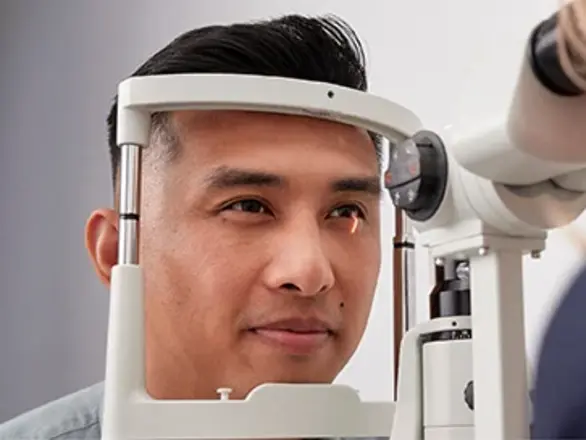
Your optometrist will check your vision and examine the front of your eye using a slit lamp, a microscope with a light that helps us spot any scratches, inflammation, infection or objects.
We may measure the pressure inside your eye (important for conditions like glaucoma) and check how your pupils react to light. We may use eye drops to widen your pupil to get a good look at the back of your eye.
We’ll explain what we’re doing and why. Once we’ve found the cause of your pain, we’ll talk you through next steps, whether simple care at home, treatment, or referral for specialist help.
Let’s get your vision sorted
Noticed your eyes hurting, or a change in your sight? Whether it’s something new or something that’s been bothering you for a while, we’re here to help.
How is eye pain treated?
An optometrist will explain what’s going on and what to do next.
Mild cases
Dry eyes or a small scratch on the surface of your eye might sound worrying, but they often clear up with a bit of care at home. Lubricating drops, a warm compress, and a short break from contact lenses can all help ease things.
Learn more about dry eye syndrome.
Infections
If your eye’s red, sore, or a bit sticky, it could be something like conjunctivitis or a stye. These are common and usually clear up with the right treatment – sometimes that means antibiotic drops or ointment to help things along.
Learn more about conjunctivitis and styes.
More serious conditions
Some types of eye pain need quick treatment – like glaucoma, iritis or a sudden injury. If the pain is severe, your vision’s changed, or light really hurts your eyes, don’t wait it out. Get it checked to avoid lasting damage.
Learn more about glaucoma
Considering surgery for eye pain?
Specsavers New Zealand doesn’t offer eye surgery, but we can guide you through your options. If you’re considering surgery, your optometrist can explain what’s available and refer you to a specialist if appropriate.
In New Zealand, eye care is mostly private for adults. Public funding rarely covers surgery unless it's linked to a medical condition. Your optometrist can help you understand the best route forward.
Your questions about eye pain, answered
Eye discomfort can be caused by dry eyes, allergies, a minor scratch or something like dust in the eye. Infections such as conjunctivitis or a stye can also make your eyes feel sore. If discomfort does not go away or comes with redness, blurred vision or light sensitivity, get it checked.
Sore eyes are often caused by dryness, allergies, eye strain or minor infections like conjunctivitis or a stye. A scratch or something small stuck in the eye can also cause soreness. If the soreness lasts or comes with redness, blurred vision or light sensitivity, see an optometrist.
Stress itself does not usually cause eye pain, but it can make you notice headaches or eye strain more. Long hours on screens can add to the problem.
See an optometrist or GP if you have sudden vision loss, severe pain, a painful red eye, flashing lights or pain after an injury. Even mild pain that lasts should be checked.
A headache behind the eye is often caused by sinus problems, tension headaches or migraines. But pain with redness, blurred vision or nausea can be a sign of something more serious like glaucoma or iritis, so get it checked.
For mild pain, rest your eyes, use a cool or warm compress and apply lubricating eye drops. Avoid rubbing your eye or wearing contact lenses. If symptoms continue, book an eye check.
High blood pressure and diabetes can affect the eyes and sometimes cause vision problems or pain. Regular eye tests are important if you have these conditions.
Did you know?
AA Members are entitled to a free eye test (valued at $60), once every two years. Remember to present your AA Membership card in‑store.
Written with care and checked for accuracy

Dabin Kim
World Health Organization (2019) World report on vision. World Health Organization Available at: https://iris.who.int/bitstream/handle/10665/328717/9789241516570‑eng.pdf?sequence=18
(Accessed: 5 December 2025)Cambridge University Press. (n.d.). Eye pain, redness and visual loss (Chapter 26). In An Introduction to Clinical Emergency Medicine. Available at: https://www.cambridge.org/core/books/an‑introduction‑to‑clinical‑emergency‑medicine/eye‑pain‑redness‑and‑visual‑loss/68893138412651F72CC8D852BFED324B
(Accessed: 5 December 2025)Cambridge University Press. (n.d.). Pain, eye (Chapter 52). In Neurologic Differential Diagnosis. Available at: https://www.cambridge.org/core/books/neurologic‑differential‑diagnosis/pain‑eye/911FE31568FAB5461DCD1AFC9006E6BF
(Accessed: 5 December 2025)Health New Zealand. (n.d.) Eyes. Available at: https://info.health.nz/conditions‑treatments/eyes
(Accessed: 5 December 2025)Healthify. (n.d.) Uveitis. Available at: https://healthify.nz/health‑a‑z/u/uveitis/
(Accessed: 5 December 2025)Health New Zealand. (n.d.) Conjunctivitis. Available at: https://info.health.nz/conditions‑treatments/eyes/conjunctivitis
(Accessed: 5 December 2025)Power, B. (2024) Disease and Health Care Burden of Ocular Pain. PubMed Available at: https://pubmed.ncbi.nlm.nih.gov/38842903/
(Accessed: 5 December 2025)Black, J.M. (2019) The changing scope of Optometry in New Zealand. Taylor & Francis Online. Available at: https://iris.who.int/bitstream/handle/10665/328717/9789241516570‑eng.pdf?sequence=18
(Accessed: 5 December 2025)
Could it be something else?
If your vision looks misty or washed out, especially in bright light or when driving at night, it could be cataracts.
When your cornea is shaped more like a rugby ball than a soccer ball, it can cause astigmatism, leading to blurred or distorted vision.
Long‑sightedness can cause blurry near vision even if your distance vision is fine.
Short‑sightedness (myopia) affects distance vision, but usually doesn’t impact close‑up tasks.
Glaucoma can develop gradually and cause vision loss if not caught early, often affecting side vision first.
Diabetes can affect the blood vessels at the back of your eye, leading to diabetic retinopathy and vision problems.
If your sight seems foggy or blurred, it could be caused by cataracts or another condition affecting your eye health.
Double vision means seeing two images of a single object, which can happen when the eyes are not aligned or working together properly
Do your eyes feel tried, sore or gritty? Dry eye could be the culprit, making vision cloudy, or as if you have glazed eyes.
This is when the edges of your eyelids get inflamed due to an infection or skin problem. It can also make the whites of your eyes appear pink or red.
Learn more about blepharitis
Seeing specks, spots or sudden flashes of light? These are common – but can also be a sign of a serious eye condition. It is worth checking out if they’re new or getting worse.
A chalazion is a blocked oil gland in the eyelid that causes a firm, usually painless lump and can lead to eyelid swelling or blurred vision.
Find out more
Why do I need an eye test?
Eye tests play a huge part in making sure your eyes stay healthy.
Check your vision
Your store visit explained
At Specsavers we are focused on caring for your eyes and giving you the best possible vision.
What to expect in‑store
More on eye tests
An eye test is not just about getting glasses – it is a vital health check for your eyes.
All about eye tests
Free exam for AA Members applies to standard eye examinations only, normally valued at $60. Excludes contact lens examination and visual field checks. Limited to one per AA Member every two years. Available to current AA Members upon presentation of AA Membership card.